Showing posts with label gas. Show all posts

Owner-Operators: Do they really earn more?

on May 06, 2014


Is owning your own truck really going to save you $$$ in the long run?


Some beg to differ.


For Samuel Slatin, his investment in his own big rig seemed to be the best decision he ever made. The hours were his own to choose from, gas was a meek 87 cents a gallon, and the paycheck came in more often.


Now, he says, things have gone from bad to worse.


Expenses have gone through the roof in more ways than one and giving up is close on his radar.

Tolls are about $100 for truckers, insurance is sky high, gas is 3.99 a gallon, and his truck gets by on only 5.2 miles a gallon.


Any slight traffic infraction could raise his insurance. His health insurance is something he can’t afford and the stress makes for a weaker heart which he now needs regular checkups for, all of which must be out-of-the-pocket, sometimes having to dish out upwards of $100 at a time.


Slatin says he left Europe, hoping for a better income and got his wish, but it was short-lived.

“I almost wish I stayed working for someone else, for a company. Being my own boss comes with all the expenses and responsibility that, at the end of the day, is costing me more!”


He points out that worker’s compensation, social security contributions, unemployment insurance, or high protection levels by safety and health regulation are just a handful of the many things he is missing out on as an owner-operator.


Back in the 1980’s, when truckers made today’s equivalent of $44.83 an hour, most of those 75,000 port truck drivers were unionized.


Now, more than half of the percentage have become independent owner operators. Initially, it was the envy of the industry – someone with his own truck and his own freedom. At this point however, independent truckers have been making an average of $28,000 a year, $7,000 less than employee drivers, who are paid by the hour and receive more comprehensive benefits. Port truckers are sometimes made to wait at the port for just one shipment for almost a day – simply because no one loses out except them, and no incentive is put in place to avoid this.


Slatin shared his musings with us:


“My marriage has been sourly affected, and I had to give up on our home mortgage because it was either that or the truck. And I need my truck to continue working. I’ve declared bankruptcy and I owe debtors. The hardest part of it all is, I am very attached and truly love my truck at this point, but I may have no choice but to sell it. The miles are high though, so it can’t be worth that much on the market by now. The saddest part is, my case is not uncommon.


“With all the expenses piling up, I have no choice but to scratch it down to bare necessities. This includes all the straps, chains, load locks and tools needed to secure my load that need replacement. If I don’t have the correct strong and sturdy securing ropes that my load requires, I could be risking a horrible accident where my load goes airborne and results in injury or worse: fatality. 

I want to thank www.DCCargoMall.com for providing me with all the equipment I need and more, and after they heard my story, have given me the discount I needed to splurge on a gift for my wife. Things are lookin’ up, slowly.”


Top Ten Overheating Prevention Steps for the Trucker

on March 11, 2014


Not only is it worth your truck's time to receive constant inspection for keeping cool, but it's worth your own time and money as well. Don't wait until parts are cracked and leaks are emerging. Catch your truck red handed before it sizzles up beyond repair.


Know if your truck is prone to overheating
Some trucks are more susceptible than others to heat; familiarize yourself with your truck’s vulnerabilities. 

Is it equipped with a less-than-ideally designed head gasket? Is your engine built with other priorities in mind? A larger engine doesn’t necessarily mean more heat resistance. Is there an old warrantee? If so, take that sucker in for a repair.


Monitor Your Gauges
There are multiple ways that your truck will actually inform
you of its current condition so that things like overheating can be caught before the actual overheating takes place. Few people actually check their temperature gauges on a regular basis and it’s a great habit to start.
 
The fuel gauge, speedometer, and tachometer are a norm for daily checks but don’t limit yourself to those gauges alone. Engine Oil pressure readings (found next to your temperature gauge) the battery charge indicator, and even the boost and vacuum gauge are all handy for keeping up-to-date with the needs of your vehicle.

To nip a failing or overheating engine in the bud, ensure that each time during your consistent gauge checks turns up with fairly stable and balanced ranges. Any rapid changes should set off warning bells. In your head that is. Repair alert!


Leaks
The guy in the car next to you motions that you roll down your window. He points to the bottom of your truck – you have a leak. Don’t ignore his warning, he deserves your thanks.

The coolant liquid – whether bright green, orange, red, or pink should not be hanging out outside the perimeters of the cooling system within your truck including the engine, transmission, brake system, transfer case, etc. If it is, you’re prone to running out of this magical liquid, and your cool-down rate is at risk. 

Don’t delay because the later you have it fixed, the more money will have to leak from your wallet. 


The Hood
Sometimes the leak is too small to notice but causes a great amount of damage to your engine. That’s why opening up your truck's insides is the next necessary step.
 
Open up that hood and dig around and check your hoses and lines for possible abrasion. Are your clamps holding snugly enough? Anything that is not up to par in shape can’t hurt to be replaced.

Ensure that your coolant is properly leveled and isn’t fluctuating in level drastically with each consistent check.


Hoses and Belts and Domino Affects
Belts and hoses are rubber, and therefore can crack, fray, leak, or rot. 

Check for these signs of wear, and check especially vigilantly for its level of tension. If the tension is off, the alternator will be forced to work harder than usual to transfer power to the other parts. This extra effort put in causes extra friction, and therefore, extra heat. Much like if you were to work extra hard at the gym and sweated it out, well, for hours.

Extra heat in the engine bay in turn raises the heat of the bay overall, which then elicits a result in the rise of your engine’s temperature. As this goes on, the heating continuously rises, and then 'bam', one day: overheated. An overheated engine leads to pressure building in the cooling system, and therefore put pressure on the hoses. 

If the cause of your rising temperatures is not obvious enough, explore the entire bay until you come across it. Remember though – before you start sniffing around a heated hood, give it some cool-off time.


Coolant-to-Water Balance
Filling up the cooling system with only water or coolant alone are both detrimental to the system. Both, at balanced levels are necessary for proper cooling operation. 50/50 is the general safe way to go, but check out your specific manual, there may be a different percentage befitting your specific system.


Although DCCargoMall.com carries all the right qualityand hefty equipment to keep even the largest loads into place, there are safetylimits and precautions that we suggest you follow if only for the fact that you are saving yourself money on overheating repairs! 

The connection between overloading and overheating? Due to all that extra weight, your engine is having to exert that much more effort to stay afloat, therefore generating more heat. It may be worth it to make that extra trip and split that load into two.

To find out what your truck’s limit is, check out your manufacturer’s weight limits and ratings from the owner manual or on a plate/decal inside the edge of your truck’s door frame.


Towing
Some trucks are tow trucks and others, well; you added a towing system to after buying. This towing addition, whether before or after, does not increase your truck’s load capacity in itself, and you will still need to abide by the loading capacity, as well as calculating the overall load weight put onto your truck, whether it’s on the trailer, roof, or otherwise.

If your towing setup is an addition made on your own, and your loads are frequently heavy-duty, it is highly suggested that you upgrade your radiator, coolant lines, and water pump to aid in dissipating extra heat. This way, whatever heavy load you do carry, (within limits range of course) will at least not be taxing on your cooling system.


Brakes
Various catalysts, such as a temperature fluctuation, a pressure rise or fall, an uneven wear of brake parts, and/or even improper braking techniques, are all ways to cause the already abrasive and high with friction brake calipers and pads to stick to the wheels. This will slow down the vehicle and in turn require extra blasts of energy – and heat – to function properly. The result? Overheating.

If you’re suspecting the dragging brake situation, get to your location if possible, and wait for cool-off time before you go prodding into the system, that is, only if you know what your doing.


Overall
Keep everything under your hood in ship-shape to avoid the overheating monster. 

Some main functions to check first would be your coolant hoses, hose clamps, radiator, engine belt, radiator cap, overflow container, cooling fan, and your engine’s thermostat, among others.

Keep cool and drive on.

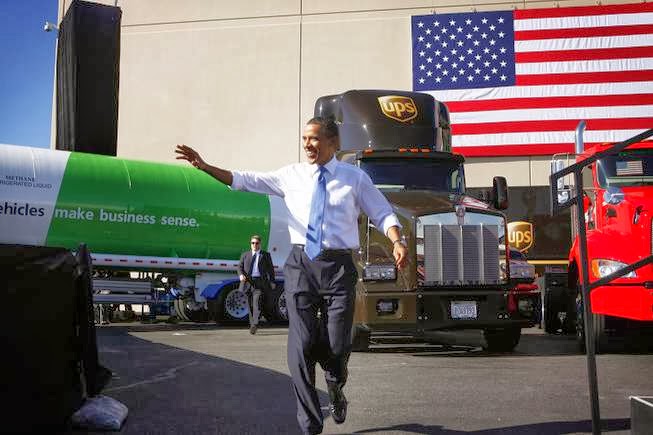
Are Obama's New Ideas Convenient for the Trucker?

on February 18, 2014


By March 31st of this year, still fresh in its 2014 status, Obama has fuel efficiency plans he wants put in place.

The platform by which the announcement has been appointed to, is the Safeway Distribution Center in Maryland, a grocery chain relevant and deserving of the chosen honor due to its advances and participation in previous EPA- led initiatives for improving the efficiency of its own fleet oftrucks.

His goal of this campaign is to set new fuel standards for trucks “so we can keep driving down oil and imports and what we pay at the pump.”

The greenhouse gas standards will be altered according to the presidential order issued to the Environmental Protection Agency and the Transportation Department’s National Highway Traffic Safety Administration.

In spite of heavy-duty vehicles accounting for only 4% of registered vehicles on the road in the US, they actually comprise 25% of road-fuel use and greenhouse gas emissions coming from the transportation sector.

The White House predicts that the country will save approximately 530 million barrels of oil – more than what was annually imported from Saudi Arabia – as well as reduce greenhouse gas emissions by 270 million tons.  How? All thanks to a previous round of fuel bolstering standards by the White House from 2011 in which the Department of Energy has provided its expertise to 23 companies with large vehicle fleets to reduce diesel and gasoline use, and transition to alternative fuels.

According to those standards, manufacturers of big rigs and semi-trucks were required to achieve a 20% fuel reduction in fuel consumption and greenhouse emissions, heavy-duty pickup trucks and vans were required to achieve a 15% reduction, and delivery trucks, buses and garbage trucks were required to achieve a 10% reduction. This has affected new models from 2014 to 2018.
The administration quite proudly forecasts that this strategy will save vehicle owners and operators $50 billion in fuel costs!

However, manufactures have responded with a dose of resistance to the dictating nature of the requests for cost improvements from Washington. However, with reducing fuel consumption as a top priority for the admin, the manufacturers have sought to be heard and speak up for shaping these rules.

As Obama considers the next phase of fuel standards, the Heavy Duty Fuel Efficiency Leadership Group, an alliance of trucking companies had this to say: “It is important to ensure flexibility and provide incentives as key attributes of any regulations going forward.”

Obama hopes to repeat his call for congress to end subsidies to oil and gas companies and alternatively create an Energy Security Trust Fund to fund research and development for progressive vehicle technologies. 

 For more ways to save plenty for your trucking business, keep safe and reduce your accident and damage rate significantly with quality loading items at nominal prices from DCCargoMall.com. 

shouldn't be volgur.